
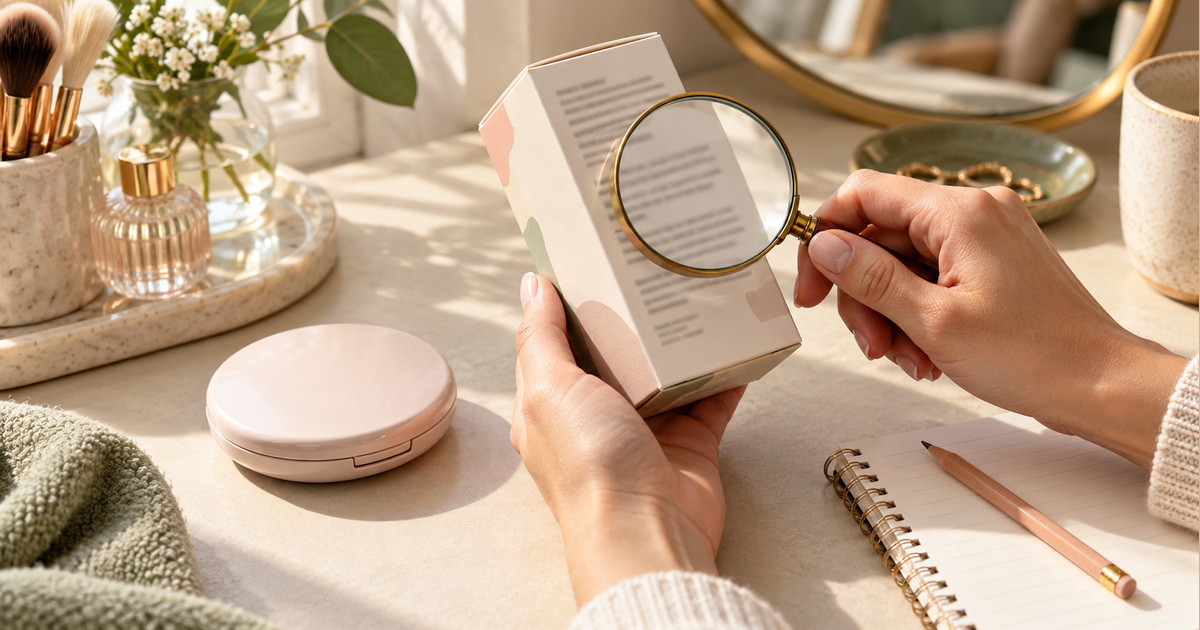
FDA’s historical result does not establish that a cosmetic you own was tested or is asbestos-free. FDA reported no asbestos detected in 50 samples tested in 2023. The supplied source excerpts do not identify products and lots, so they cannot establish a match to your package. Treat the finding as a bounded sampling result, not product certification.
By linfengzhu
What the two FDA pages establish
The FDA talc overview provides ingredient and contamination context: talc is a naturally occurring mineral used in cosmetics, and talc deposits can occur near asbestos, creating potential for contamination. That background explains the testing question; it does not establish contamination in a particular cosmetic.
The FDA 2023 testing update supplies the narrower finding. AMA Analytical Services tested samples using polarized light microscopy (PLM) and transmission electron microscopy (TEM). FDA selected and purchased products, then blinded the samples before transfer to AMA. Selection factors included product type, price, marketing and possible third-party contamination reports. Those details should accompany interpretation of the result; the excerpt does not establish a statistically representative survey of the entire market.
Both FDA pages used here were captured on October 23, 2026 (UTC). That is the source-capture date, not the testing year or a new test of products currently for sale.
A scope-matching worksheet
This is an editorial worksheet to fill in, not a completed investigation. Keep package observations separate from statements in a testing record. Use unknown whenever either side lacks information; a blank is not a match.
| Field | What to record and compare |
|---|---|
| Product identity | Copy the brand, exact product name and variant from your package. Compare with an identified testing record, not just a similar name. No match is established here. |
| Lot or batch | Record any lot or batch marking you can find. If either record lacks it, leave lot matching unknown; do not substitute a brand-level match. |
| Sampling year | Enter 2023 for this FDA result. Record your purchase information separately; buying something later does not connect it to the historical sample. |
| Testing methods | Enter PLM and TEM for the reported assignment. Do not assume an unrelated manufacturer statement used the same methods. |
| Reported result | Preserve the wording “asbestos not detected” and its sample scope. Do not rewrite it as a guarantee about every unit or every possible hazard. |
| Unresolved gaps | List missing identity details, lot information and any unavailable method or reporting details. Keep these visible beside the conclusion rather than filling them by assumption. |
Use the worksheet without overstating the answer
- Start with the package. Transcribe what is actually readable. If a marking is unclear, record that uncertainty instead of guessing.
- Seek a traceable record. You could ask the manufacturer whether it can provide testing information tied to your exact product and lot, including methods and result wording. This suggestion does not mean such documentation exists or will be supplied.
- Write a scope-limited conclusion. Until identifying evidence is available, use: “The supplied FDA summary does not establish whether my product or lot was among the samples.” Neither assume a match nor infer contamination from missing information.
Hypothetical example: suppose a separate report names a powder with the same brand and product name as yours, but gives no lot number. You would record a possible product-name match and an unknown lot match. You would not turn that partial connection into evidence that the unit in your hand was tested.
Keep different questions separate
A historical asbestos sampling result is not a general safety assessment of your cosmetic. This article does not evaluate cancer risk, determine whether you should use a particular product, or assess current testing-rule requirements. Those questions are not answered by matching a package to this summary.
If your separate question concerns ingredient disclosure, see PFAS in U.S. cosmetics: what labels reveal and what to ask next. That is a different evidence question; it should not be used to infer shared risks or testing methods for PFAS and talc.
This reading is limited to the supplied FDA excerpts, not a review of underlying laboratory reports. Revisit the worksheet if product-and-lot records, fuller testing details or a revised FDA result become available. Until then, unknown fields should remain unknown.

